
Jump to
Which gutter problems can be repaired?
Single faults usually can. A leaking joint, a sagging stretch, a crushed downspout, a short piece of rotten fascia or a run knocked down by a branch can be fixed without replacing the whole system.
| What you see | Common cause here | Usual fix | More detail |
|---|---|---|---|
| Dripping at a corner or end | Sealant cracked by heat and cold | Clean back and reseal | Leaking gutters |
| Run tipping out or bowing | Loose spikes, wet leaves, soft board | Hang again on screw-in hangers | Sagging gutters |
| Gutter bent or pulled down after ice | Ice load and falling limbs | Replace sections, re-hang | Ice damage |
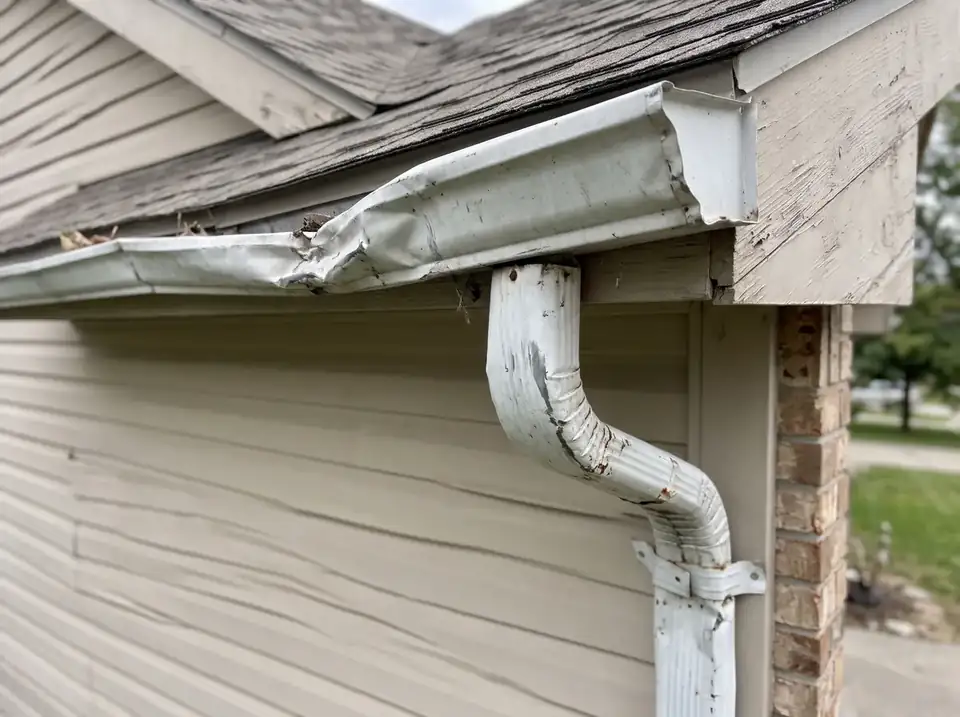
| Creased or torn section after wind | Branches, straight-line winds | Replace the section | Storm damage |
| Downspout crushed or leaking | Mowers, cars, loose straps | Swap the section, re-strap | Downspout repair |
| Board behind the gutter dark or spongy | Water getting behind the trough | New fascia and an apron | Fascia and soffit |
What happens on a repair visit?
- Find the fault with water. A hose shows exactly where water escapes or pools instead of guessing from stains.
- Clear the trough. Leaves and grit come out so joints and hangers are visible.
- Sight down the run. A level or string line shows dips and backward slope.
- Probe the wood. Fascia is tested at corners and anywhere it looks stained.
- Make the fix. Reseal, re-hang, swap a section or a downspout as needed.
- Run water again. The repair is proven before the ladder comes down.
- Tell you what is next. A straight answer on how long the rest of the system has.
Why do Memphis gutters fail?
Ice. Freezing rain is the city's harshest gutter test. The February 2022 ice storm left up to half an inch of ice across Memphis and Shelby County and affected 233,460 MLGW customers. Ice adds weight to the gutter itself and brings down the limbs above it.
Wind. The July 2003 windstorm brought gusts above 100 mph and left over 300,000 homes without power. Straight-line winds in spring and summer storms rip loose runs off the fascia and drop branches on the rest.
Old fixings. Spike and ferrule was standard for decades. Spikes back out as fascia swells and dries, so older gutters sag and pull away.
Leaf weight. A gutter packed with wet oak leaves, acorns and seed pods is heavy, and the load sits on whatever hangers are left.
Water behind the trough. With no drip edge or apron, rain runs down the shingles and behind the gutter, softening the fascia and every screw in it.
Is it time to repair or replace?
| What you see | Fix it | Replace it |
|---|---|---|
| Leaks | One or two joints | Most of the joints, or old sectional gutter |
| Sagging | A single stretch on sound wood | Long runs on soft fascia |
| Rust | Not on aluminum | Galvanized steel rusting through |
| Overflow | Only once outlets block | Every heavy rain, even clean |
| Age | Younger than about 20 years | Over 30, spiked and patched |
See repair or replace your gutters.
What do repairs cost?
Repair work is usually priced by the job or the item: sealing joints, re-hanging a run, swapping a downspout. Fascia tends to go by the foot. No one publishes Memphis repair rates, so have each item listed on the written quote.
Can I do it myself?
Many homeowners can clean and reseal a single-storey gutter from a steady ladder on a dry day. Long re-hangs, new fascia and anything on a second storey call for the right ladders, stand-offs and experience. If you climb, keep three points of contact and do not lean out beyond the rails.
Water pouring over the front in a spring storm
Memphis gets more rain in April than any other month, and a hard burst can swamp a 5-inch gutter draining through a single 2x3 leader. When the outlet is open and the slope is right, the gutter is simply undersized: 6-inch gutter, 3x4 downspouts or an extra drop is the fix. See 6-inch gutters.
Gutters bent or torn off after freezing rain
Half an inch of ice on a gutter and the limbs above it adds a lot of weight. Spikes pull out, hangers bend and branches land on the run. See ice damage.
Packed with oak leaves and acorns
Oaks shed late, often into December, and acorns and catkins plug outlets. A fine mesh guard keeps both out. See oak trees and gutters.
A steady drip from a corner or end cap
Summer heat and winter cold work the sealant loose. The joint is scraped, cleaned and resealed on dry metal. See leaking gutters.
The run is leaning out or hanging low
Spikes have backed out of the fascia or the board behind has gone soft. The wood is replaced and the run re-hung on screw-in hangers. See sagging gutters.
Soil washing out or a damp crawl space
A downspout is emptying beside the foundation. Silty loess soil erodes fast once bare. Extend or bury the line. See drainage and your foundation.
Repair terms
| Word | What it means on a Memphis job |
|---|---|
| Sealant | Flexible gutter-grade compound laid into seams, corners and around outlets |
| Spike and ferrule | The older fixing: a long nail through the front of the gutter and a sleeve that keeps it from crushing |
| Hidden hanger | A bracket that clips under the gutter lip inside the trough and is screwed back through the gutter into the fascia |
| Strip miter | A corner joined by a separate strip of metal riveted and sealed across two angled ends |
| Box miter | A pre-formed corner piece with a socket for each run, which adds a seam on both sides |
| End cap | The flat piece that closes the open end of a gutter run |
| Outlet | The drop fitted through the gutter floor that connects to the downspout |
| Fascia | The trim board fixed to the ends of the rafters along the eave; gutter hangers screw into it |
| Drip edge | An L-shaped metal strip nailed along the eave under the first row of shingles, so runoff drops clear of the wood and into the trough |
| Gutter apron | A longer flashing tucked under the shingles that laps down into the gutter, sealing the gap a short drip edge leaves |
| Cleanout | A removable cap or fitting where a downspout meets an underground pipe, used to clear blockages |