
Jump to
- How do you know gutters need replacing?
- What does a full replacement involve?
- Why replace instead of patching again?
- What usually changes?
- What does replacement cost?
- New roof, new gutters?
- Do historic districts affect replacement?
- Do I need a permit?
- What gets removed and what stays?
- How long does a replacement take?
- Replacement terms
How do you know gutters need replacing?
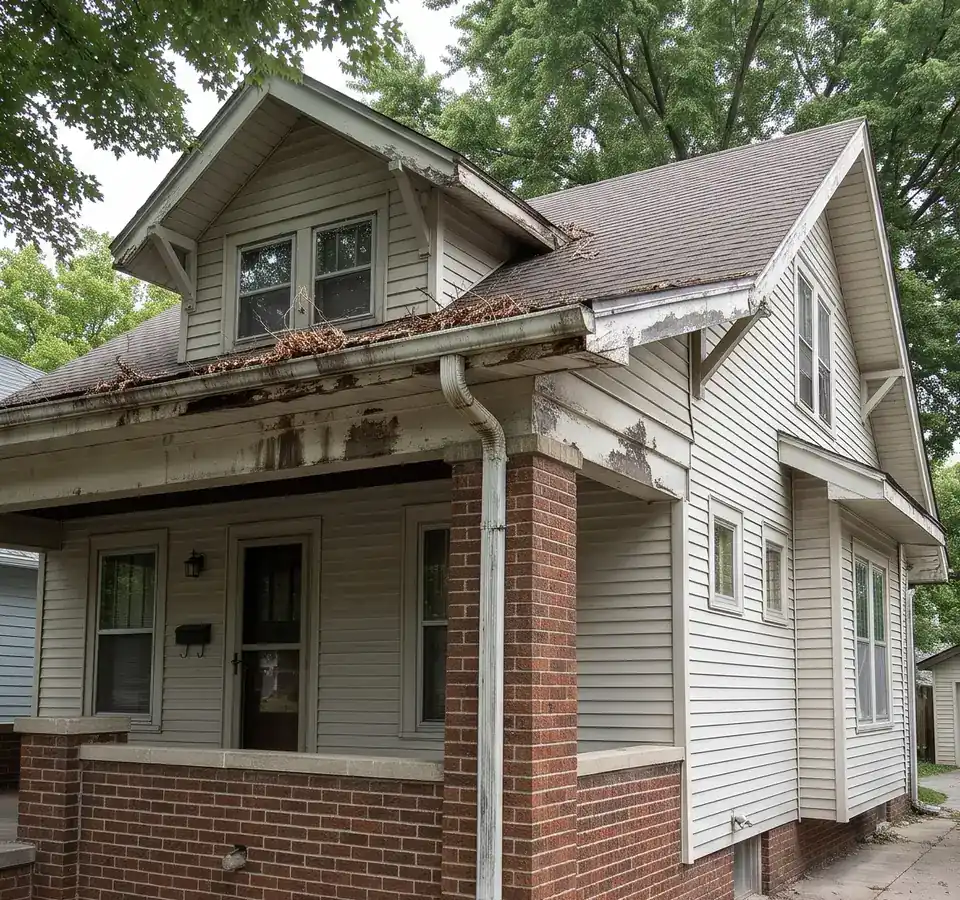
When the faults are spread around the house rather than in one spot: leaking joints on several walls, sagging runs, rust in steel, overflow in every hard rain even when clean, and fascia going soft behind long stretches.
| Sign | What it tells you | Verdict |
|---|---|---|
| Most corners and seams dripping | Sealant has given out everywhere | Replace if the gutters are old or sectional |
| Spikes backing out on more than one wall | Both fixings and wood are worn | Replace, with fascia repairs |
| Rust spots or holes in steel | The metal itself is going | Replace |
| Overflow in every downpour when clean | Undersized gutters and downspouts | Replace with 6-inch and 3x4 |
| Peeling paint and soft fascia | Years of water behind the gutter | Replace gutter and board together |
| One bent section after a storm | Isolated damage | Repair |
What does a full replacement involve?
- Measure and plan. Every eave and outlet is recorded, and downspout positions are kept or moved.
- Strip the old system. Gutters, downspouts, spikes and hangers come off; spike holes are noted.
- Expose the wood. With nothing in the way, soft fascia and rafter tails are easy to find and replace.
- Fix the roof edge. Drip edge or a gutter apron goes where water has been getting behind.
- Form new runs. Seamless gutter is made to each wall on site.
- Hang on hidden hangers. About every two feet, with steady fall to each outlet.
- Upgrade the downspouts. Often from 2x3 to 3x4, with extra outlets on long runs.
- Lead water away. Extensions, splash blocks or buried lines carry it clear of the foundation.
- Haul away and test. Old metal leaves with the crew and every run gets a hose test.
Why replace instead of patching again?
Too small for the roof. Many houses carry 5-inch gutters and 2x3 downspouts on roofs that would be far better served by 6-inch and 3x4. April storms, in Memphis's wettest month, expose that every year.
Tired fixings. Spike and ferrule loosens as the wood swells and shrinks. Re-driving spikes buys a season. New hidden hangers into sound wood last.
Rotten wood. Where water has run behind the gutter for years, the fascia goes soft. Doing gutter and fascia together avoids paying for scaffolding and setup twice.
Better drainage. The loess soils of the Chickasaw Bluffs wash away readily when bare. A replacement is the moment to send each downspout somewhere sensible.
Ice resilience. Freezing rain, like the February 2022 storm that cut power to more than 233,000 MLGW accounts, loads gutters and drops limbs on them. Spiked runs on soft fascia are the weakest point; a fresh system on screw-in hangers into sound wood holds up better.
What usually changes?
| Part | Old system | New system |
|---|---|---|
| Width | 5-inch | 6-inch on two-storey houses and under valleys |
| Metal | Thin 0.027-inch aluminum or galvanized steel | Heavier 0.032-inch aluminum |
| Joints | Seams on sectional runs | Seamless, joined only at corners |
| Fixings | Spikes and ferrules | Screw-in hidden hangers at 2-foot centers |
| Leaders | 2x3 | 3x4 |
| Outfall | A splash block at the wall, or none | Extension or underground pipe to daylight |
| Guards | Nothing, or tired old screens | Micro-mesh where trees overhang |
What does replacement cost?
Angi and This Old House give a national band of about $9 to $13 per installed foot for 5-inch seamless aluminum, and $12 to $18 for 6-inch. Memphis quotes will land wherever the house puts them. Removing the old system, fascia work, added downspouts, underground pipe and guards are normally priced on top. The Memphis cost guide has sample totals.
New roof, new gutters?
Often. Roof tear-offs tend to knock gutters about, and new drip edge decides where the gutter should sit. When gutters are past about twenty years old, doing both jobs together saves setting up twice. If they are younger and sound, they can usually come down and go back up.
Do historic districts affect replacement?
Some Midtown neighborhoods such as Central Gardens and Cooper-Young are historic districts. Exterior changes in locally designated districts can need review, so ask the city before changing a gutter's style or material on a historic house.
Do I need a permit?
Swapping gutters like for like usually does not, but larger drainage work can. A contractor who works regularly in Memphis or your suburb should know what the local building office expects.
What gets removed and what stays?
The old gutters, downspouts, hangers and spikes come off and are hauled away. Sound fascia stays and is repaired where needed. Buried lines are tested and reused if they drain, or replaced. Drip edge is added if missing.
How long does a replacement take?
Most homes are done in a day. Fascia repairs or buried drain lines can add a second day.
Replacement terms
| Word | What it means on a Memphis job |
|---|---|
| Fascia | The trim board fixed to the ends of the rafters along the eave; gutter hangers screw into it |
| Rafter tail | The cut end of a roof rafter that projects past the wall and carries the fascia |
| Drip edge | An L-shaped metal strip nailed along the eave under the first row of shingles, so runoff drops clear of the wood and into the trough |
| Gutter apron | A longer flashing tucked under the shingles that laps down into the gutter, sealing the gap a short drip edge leaves |
| Spike and ferrule | The older fixing: a long nail through the front of the gutter and a sleeve that keeps it from crushing |
| Hidden hanger | A bracket that clips under the gutter lip inside the trough and is screwed back through the gutter into the fascia |
| K-style | The common house gutter shape: flat back, decorative ogee face, sold in 5 and 6 inch widths |
| Gauge | Metal thickness: 0.027 or 0.032 inch for aluminum, 16 or 20 ounce per square foot for copper |
| Downspout | The vertical pipe that carries water from the outlet down the wall, also called a leader |
| Splash block | A ribbed pad at the foot of a downspout that spreads the flow so it does not dig a hole |
| Buried drain line | Solid pipe laid under the yard that carries downspout water to a lower spot, a curb outlet or an emitter |