
Jump to
- Half-round gutters explained
- Which Memphis houses suit half-round?
- How is half-round hung?
- What metal should half-round be?
- Can half-round handle Memphis rain?
- Do historic districts affect gutter choices?
- How is half-round priced?
- Which Memphis houses suit half-round?
- What size half-round do I need?
- How are the brackets fixed?
- Half-round terms
Half-round gutters explained
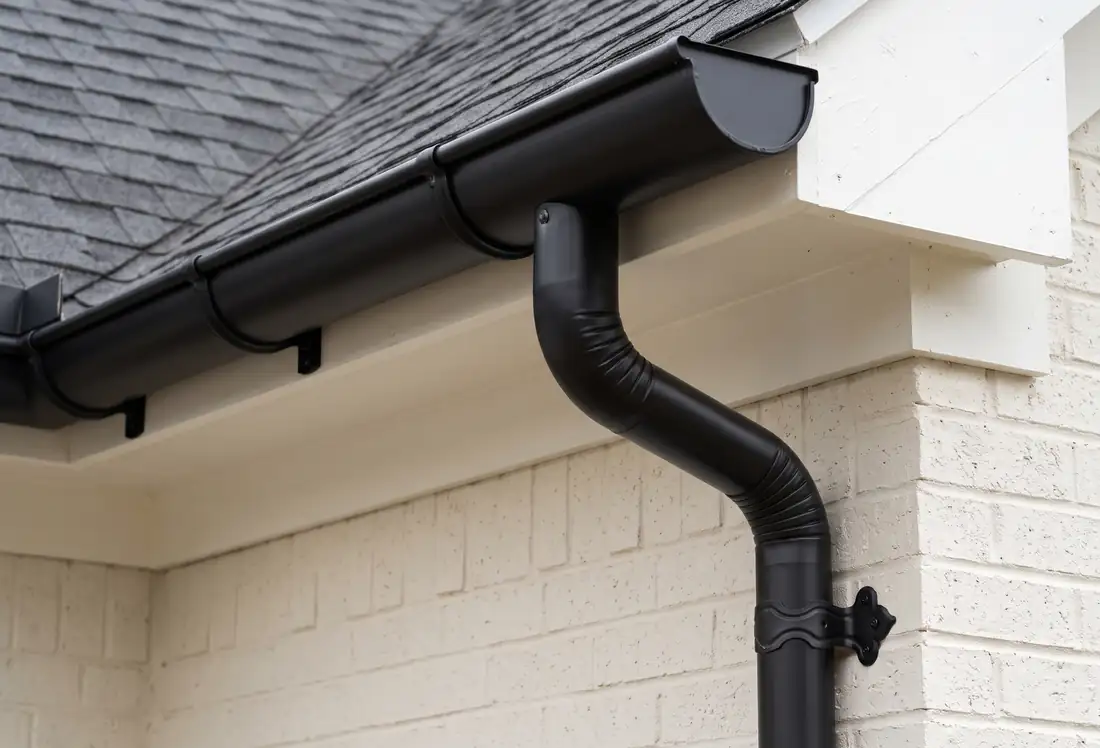
A semicircular trough, usually 5 or 6 inches wide, held in brackets fixed to the fascia, rafter tails or roof deck. It drains through round downspouts, typically 3 or 4 inches across. It was common before K-style took over and is still chosen where looks matter.
| Half-round | K-style | |
|---|---|---|
| Shape | Semicircle | Flat back, ogee face |
| Fixing | External brackets | Hidden hangers inside |
| Capacity at the same width | Lower | Higher |
| Leaders | 3-inch or 4-inch round | 2x3 or 3x4 rectangular |
| Metals | Copper, aluminum, galvanized, zinc | Mostly aluminum |
| Cost | Higher | Lower |
Which Memphis houses suit half-round?
- Central Gardens. Built largely between 1850 and 1930, the neighborhood is full of American foursquares, bungalows and revival styles where half-round looks original.
- Cooper-Young and other Midtown streets. Craftsman bungalows with open eaves and exposed rafter tails take brackets well.
- Older homes in Germantown and Collierville. Houses near the historic cores often suit a softer profile.
- New traditional-style homes. Farmhouse and colonial designs sometimes specify half-round, occasionally in copper.
How is half-round hung?
- Choose brackets. Fascia-mount for a flat board; rafter or strap brackets for open eaves.
- Snap the line. A chalk line sets about a quarter inch of fall per ten feet.
- Fix brackets. Spaced roughly every 2 to 3 feet, each set to the line.
- Lay the gutter in. The trough sits in the brackets and is clipped or sprung in place.
- Join the sections. Couplers and sealant on aluminum, solder on copper.
- Add round downspouts. With plain or decorative straps.
- Test. Water run through checks slope and joints.
What metal should half-round be?
| Metal | Lifespan | Look | Cost |
|---|---|---|---|
| Copper, 16 or 20 oz | Very long | Bright, then brown, then green | Highest |
| Aluminum, prepainted | Decades | Wide color range | Least |
| Galvanized steel | Long, if kept painted | Bare or painted | Middle |
| Zinc | Very long | Soft gray | High |
See copper gutters and aluminum vs steel vs copper.
Can half-round handle Memphis rain?
Its rounded trough holds less than a K-style of equal width, so go up a size. Most houses need 6-inch half-round on 4-inch round leaders, plus a leader near each valley. With April averaging close to six inches, a half-round that is too small will overflow.
Do historic districts affect gutter choices?
In locally designated historic districts, changes to the outside of a house can need review. If you live in one, ask the city before switching gutter style or material.
How is half-round priced?
It costs more than K-style, and copper costs far more than aluminum; national guides put copper at around $25 to $40 a foot. Ask for a quote that names the metal and its weight or gauge, the bracket type and spacing, and the leader size.
Which Memphis houses suit half-round?
Half-round was the usual gutter before the 1950s, so it fits bungalows, foursquares and revival-style houses in Midtown, Central Gardens and older parts of Germantown and Collierville. It also suits newer homes designed in traditional styles. On a typical 1970s ranch it can look out of place.
| Feature | Half-round | K-style |
|---|---|---|
| Look | Traditional, rounded | Modern, crown-molding front |
| Capacity at the same width | Lower | Higher |
| Fixing | External brackets | Hidden hangers |
| Cleaning | Smooth inside, easy to rinse | Corners can trap debris |
| Materials | Aluminum, copper, steel | Mostly aluminum |
| Cost | Higher | Lower |
What size half-round do I need?
Because a half-round trough holds less than a K-style of the same width, a 6-inch half-round is usually the minimum on a two-storey house, with 3-inch or 4-inch round downspouts. Smaller cottages may manage with 5-inch half-round if there are enough downspouts.
How are the brackets fixed?
Brackets screw into the fascia, or, on houses with exposed rafter tails, into the side or top of each rafter. Spacing should be about 2 to 3 feet, closer where ice is a concern. Copper half-round needs copper brackets.
Half-round terms
| Word | What it means on a Memphis job |
|---|---|
| Half-round | A semicircular open gutter carried in brackets, seen on older and period houses |
| Bracket | A strap or cradle mounted on the fascia or roof deck that the gutter sits in, used for half-round |
| K-style | The common house gutter shape: flat back, decorative ogee face, sold in 5 and 6 inch widths |
| Outlet | The drop fitted through the gutter floor that connects to the downspout |
| End cap | The flat piece that closes the open end of a gutter run |
| Downspout | The vertical pipe that carries water from the outlet down the wall, also called a leader |
| Strap | The band that holds a downspout tight to brick or siding |
| Gauge | Metal thickness: 0.027 or 0.032 inch for aluminum, 16 or 20 ounce per square foot for copper |
| Fall | The slope a gutter is hung at toward its outlet, typically about a quarter inch every ten feet |